 Experience
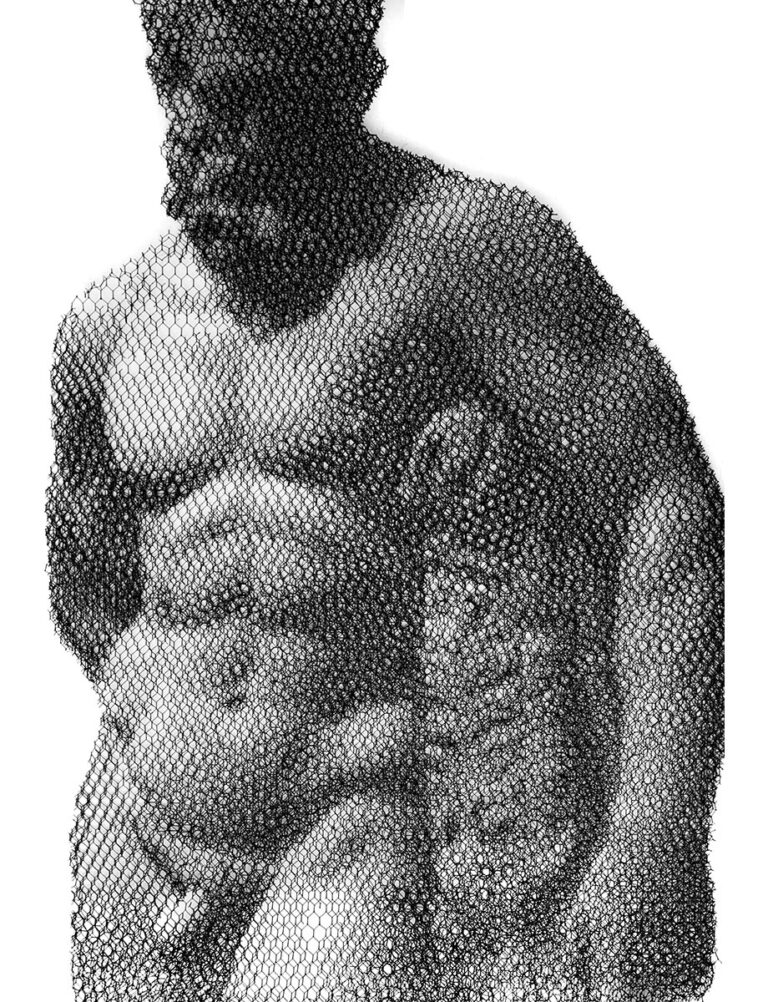
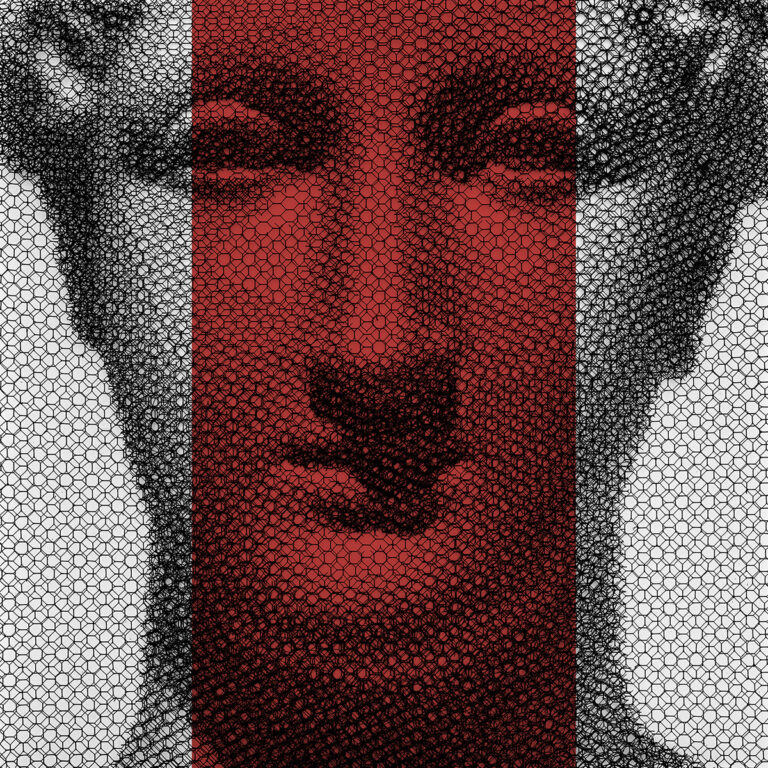
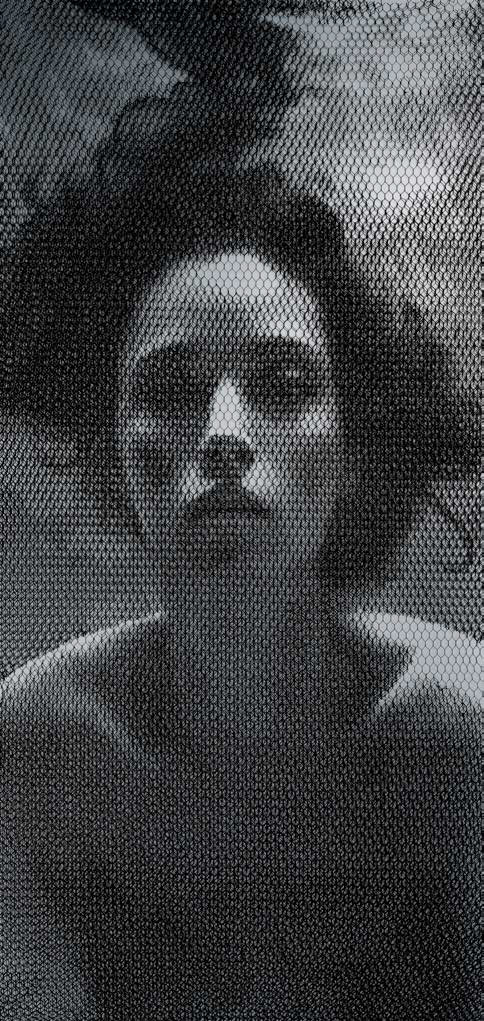
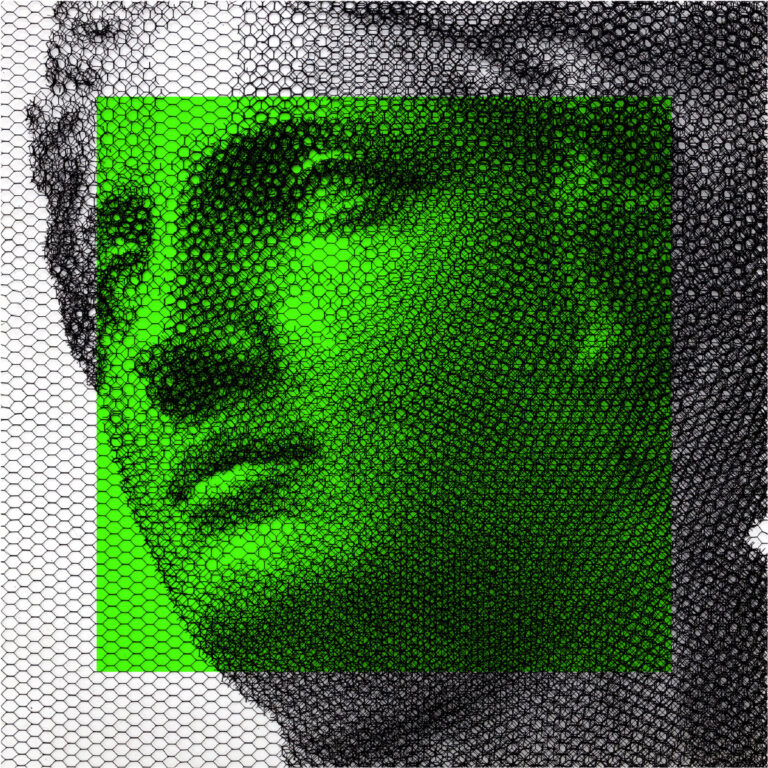
Knowledge does not coincide with an accumulation of information, but with a process of construction. It can be understood as organization — when what has been lived is ordered, analyzed, made legible — or as a starting point, when an already defined structure invites questioning the conditions that generated it. In both cases, knowledge is never immediate: it is always the result of mediation. Here, the body is no longer only experience, but an object of observation. It is analyzed, measured, interpreted. It is no longer immersed, but placed at a distance. It is through this distance that it becomes knowable. The space that hosts this section makes this transformation explicit. The decorative apparatus, of Neoclassical origin, is constructed according to a rigorous order, in which every element finds a precise placement. At the center of the vault, the Allegory of Virtue introduces a higher principle, guiding and governing the reading of the entire environment. On the walls, the scenes of Mucius Scaevola and Iphigenia establish two exemplary models: control of the body through will and sacrifice as a necessary choice. In both cases, the body becomes a place of decision, no longer only of experience. The space thus configures itself as a disciplinary system, in which knowledge is linked to measure, order, responsibility. Nothing is left to chance: every element contributes to defining a readable structure. In this condition, the mesh assumes a different function compared to the previous room. It is no longer a diffuse environment, but a device of organization. It filters, selects, relates. As in scientific research, knowledge does not emerge from an indistinct totality, but from a process of reduction and clarification. The figures that inhabit this space — Hermes, Mercury, Hippocrates, Jupiter, Minerva, Apollo, and Calliope — represent different modes of knowledge: transmission, method, vision, strategy, order, language, memory. They do not embody abstract knowledge, but concrete practices: different ways of constructing, organizing, and making operational what has been observed. Within this horizon also lies contemporary research, which increasingly operates as a system of relationships. Scientific knowledge is not an isolated domain, but an active network, where data, expertise, and technologies intertwine to produce verifiable results. In the Prince’s Apartments of the Reggia di Colorno, a space historically built to represent order and hierarchy, this dimension finds a natural correspondence. The architecture itself becomes part of the process: not only container, but model. In this space, what has been lived takes form, becomes a system, acquires structure. But this structure is not definitive. It can be traversed, questioned, transformed, or reinterpreted as the outcome of an already completed process. Crossing this space, one awareness emerges: to know does not mean to possess, but to build a relationship between what is observed and the way it is interpreted.
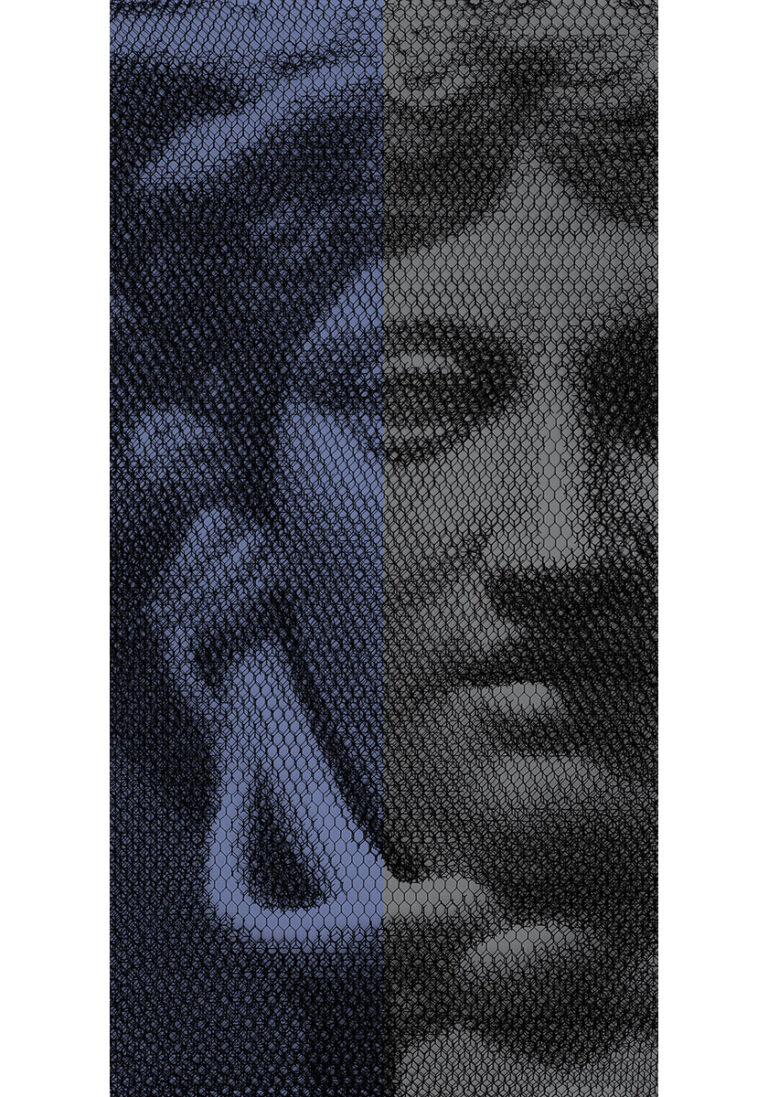
Hermes is the messenger, the mediator between worlds. He is the figure of passage, of translation, of circulation. In mythology, he crosses boundaries: between human and divine, between visible and invisible, between life and death. He represents a dynamic form of knowledge, one that is not built through accumulation but through transmission. Knowledge exists only if it can be shared, if it can move from one point to another, transforming along the way. This dimension introduces the idea of knowledge as an active network: a system in which information circulates, connects, and is re-elaborated. Nothing remains isolated; everything acquires meaning through movement. The metal mesh reflects this condition. The image emerges as if crossed by lines of passage, as if constructed through a system of connections rather than a closed form. The face appears stable, yet is the result of a continuous internal transmission.
HERMES – VISTA 041882 (PAGAN POETRY), 2025
hand-cut black wire mesh on white background
160 × 80 cm.
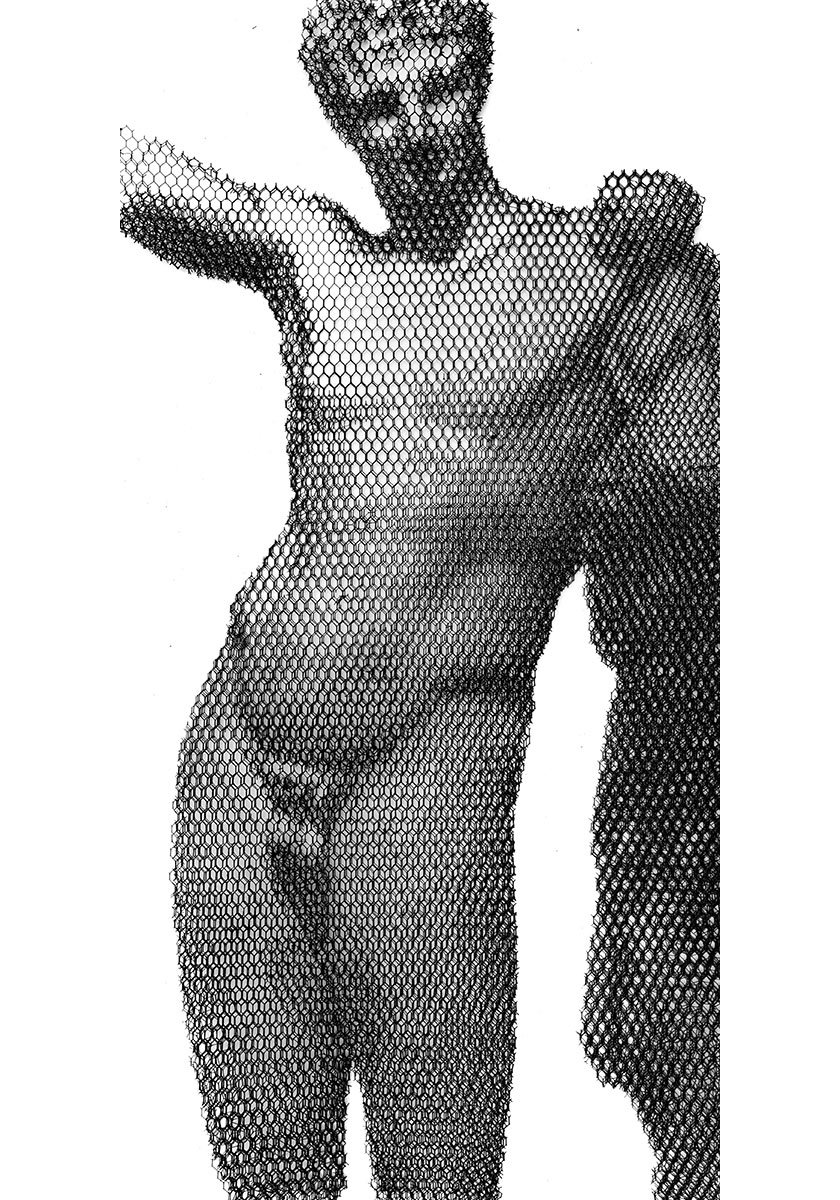
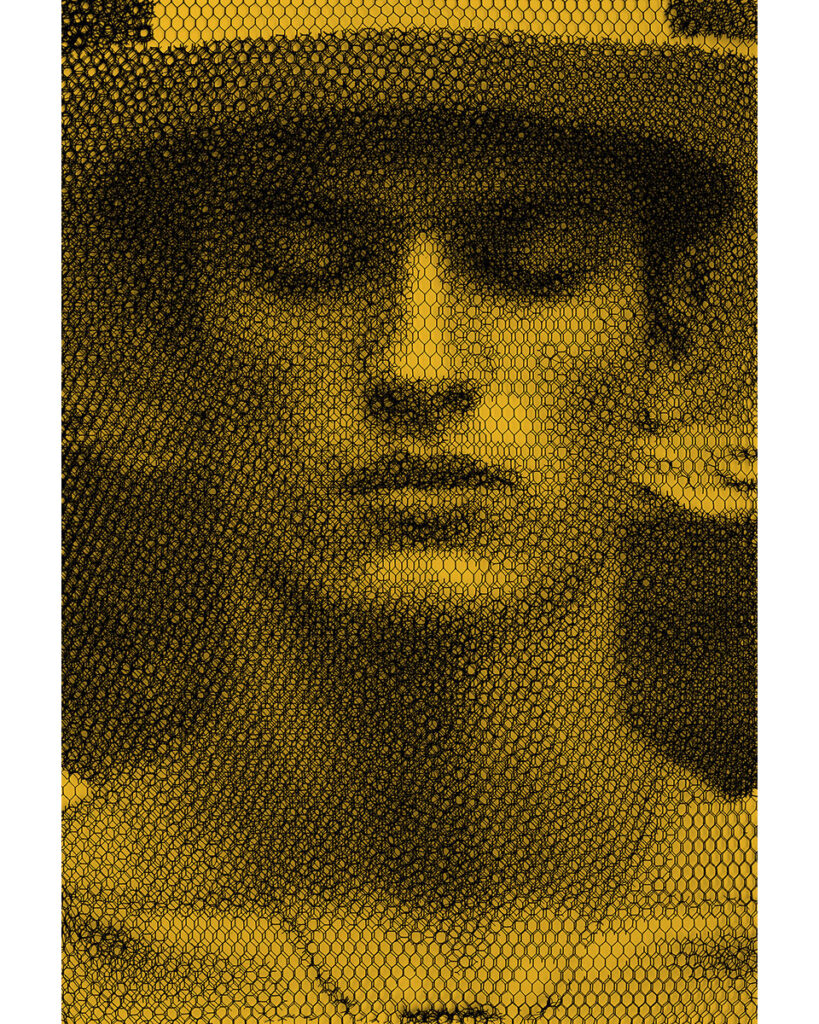
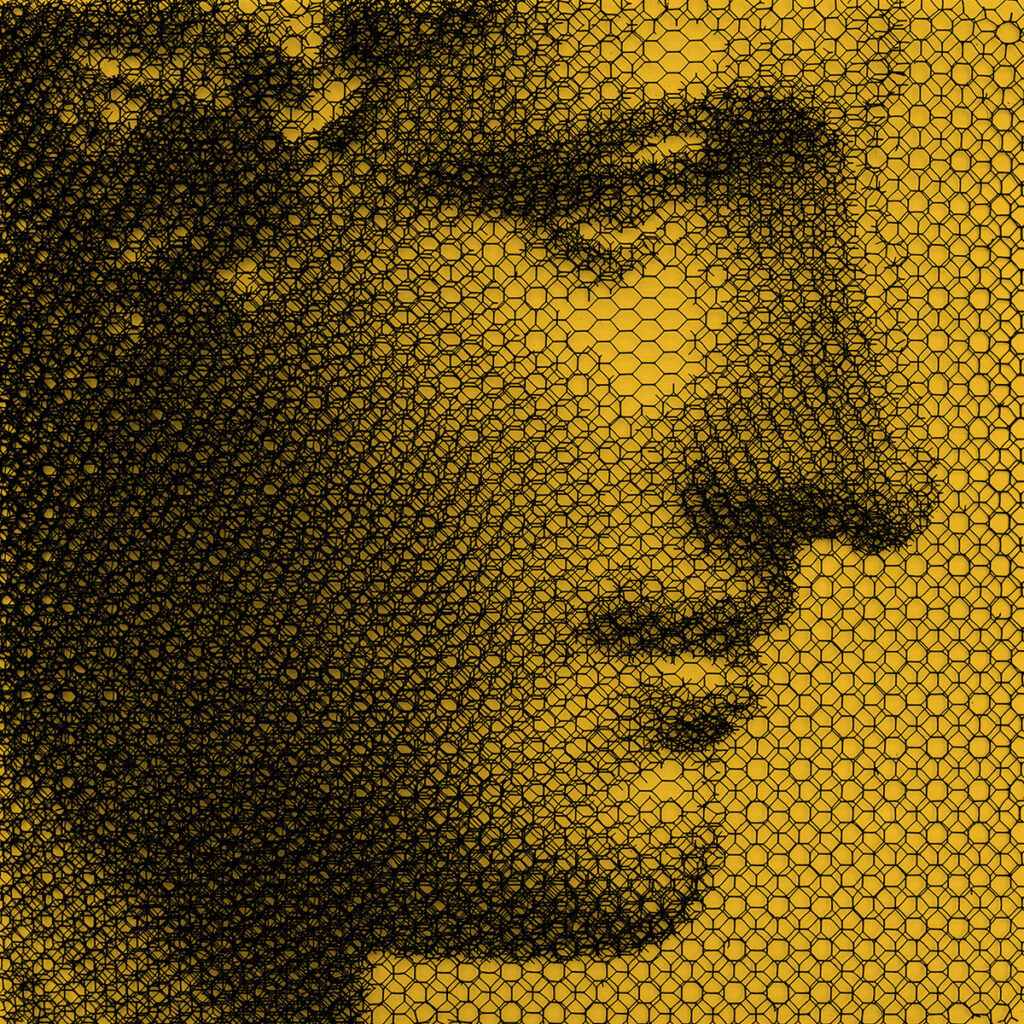
Mercury is the Roman counterpart of Hermes, but here it takes on a more contemporary quality: speed, fluidity, adaptability. It is intelligence in motion, able to move through complex systems without becoming fixed. It represents an accelerated form of knowledge, capable of connecting different domains and generating relationships in ever shorter times. Knowledge is no longer slow and sedimented, but circulating, updated, in constant movement. This figure introduces a dimension in which knowledge approaches contemporary models of processing: systems capable of reworking information on a large scale, generating new configurations. The metal mesh conveys this dynamic. The face emerges from a structure that seems to vibrate, as if crossed by a continuous flow. The image is not static, but suggests a condition in constant redefinition.
MERCURY – ALGOR. 3231545 (EÍDŌLON), 2024
hand-cut black wire mesh on saffron yellow background
125 × 85 cm.
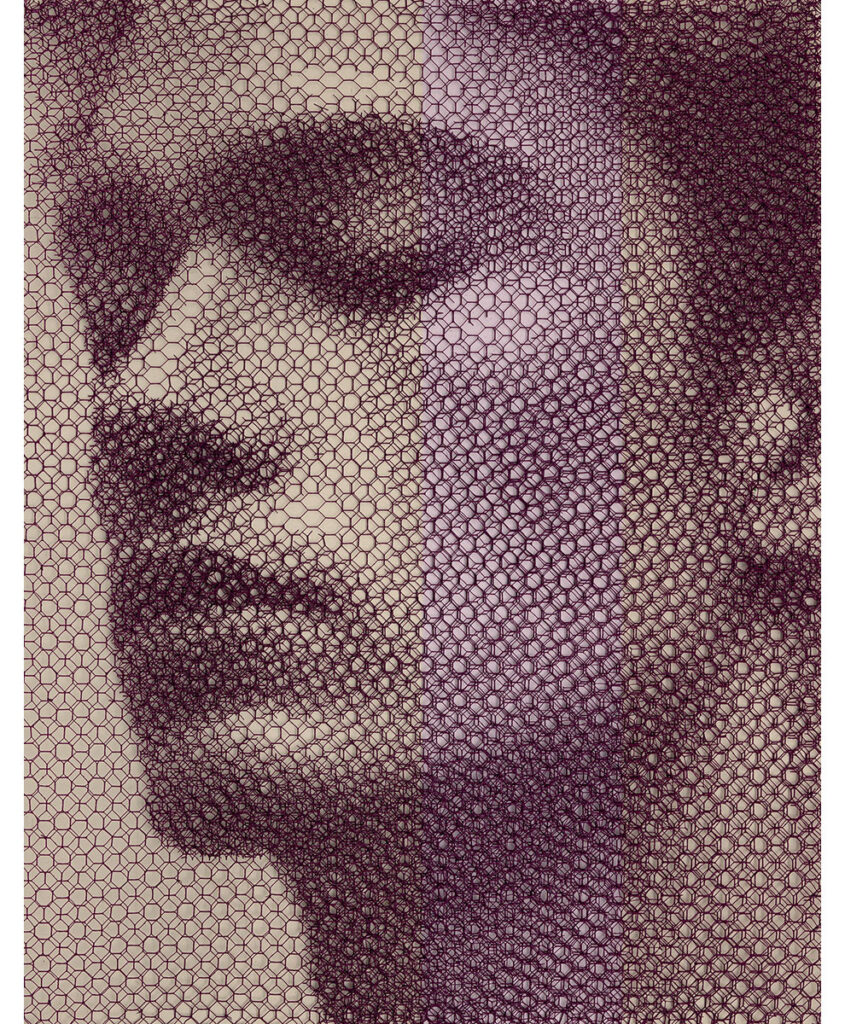
Hippocrates marks a fundamental transition: from mythological narrative to systematic observation. He is the figure who introduces method, the necessity of observing the body as a field of investigation, recognizing patterns, and constructing verifiable hypotheses. He represents a form of knowledge grounded in experience, but not limited to perception. Knowledge is built through repeated observation, comparison, and sharing. This transformation is central: the body is no longer only lived, but interpreted. It becomes readable, analyzable, inserted into a system of relations that allows its functioning to be understood. The metal mesh here takes on an almost analytical value. It filters, selects, reduces complexity to make it observable. The image appears more controlled, as if the result of a process of reading.
HIPPOCRATES – ALGOR. 2441624 (EÍDŌLON), 2024
hand-cut magenta wire mesh on powder pink and ivory background
90 × 70 cm.
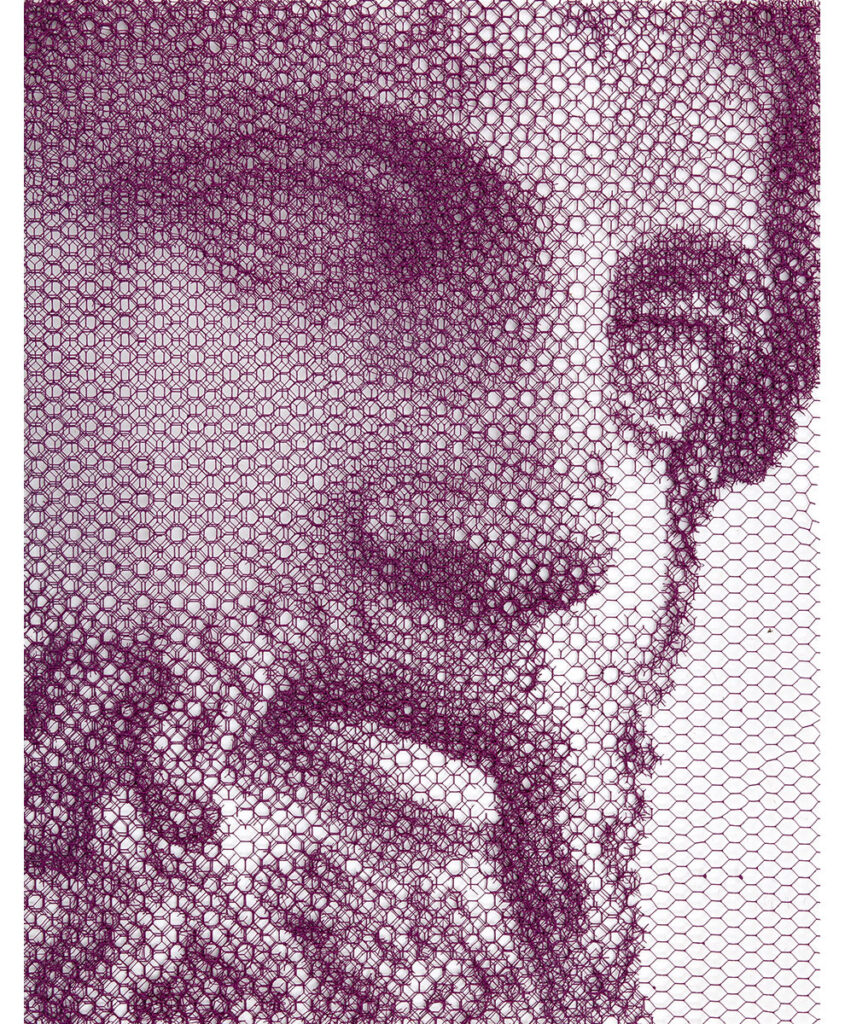
Jupiter is order, structure, vision. He is the figure that organizes multiplicity, that gives form to a complex system, that establishes hierarchies and relationships. He represents a form of knowledge capable of holding together different elements, constructing a coherent framework out of complexity. He does not merely collect data, but arranges it according to a logic. This dimension introduces the theme of strategic vision: the ability to orient knowledge, to define priorities, to shape a readable system. The metal mesh here behaves like an ordering grid. The image emerges with greater clarity, as if the structure itself imposed a form, reducing ambiguity and strengthening legibility.
JUPITER DE VERSAILLES – VISTA 011314 (PAGAN POETRY), 2023
hand-cut magenta wire mesh on white background
90 × 70 cm.
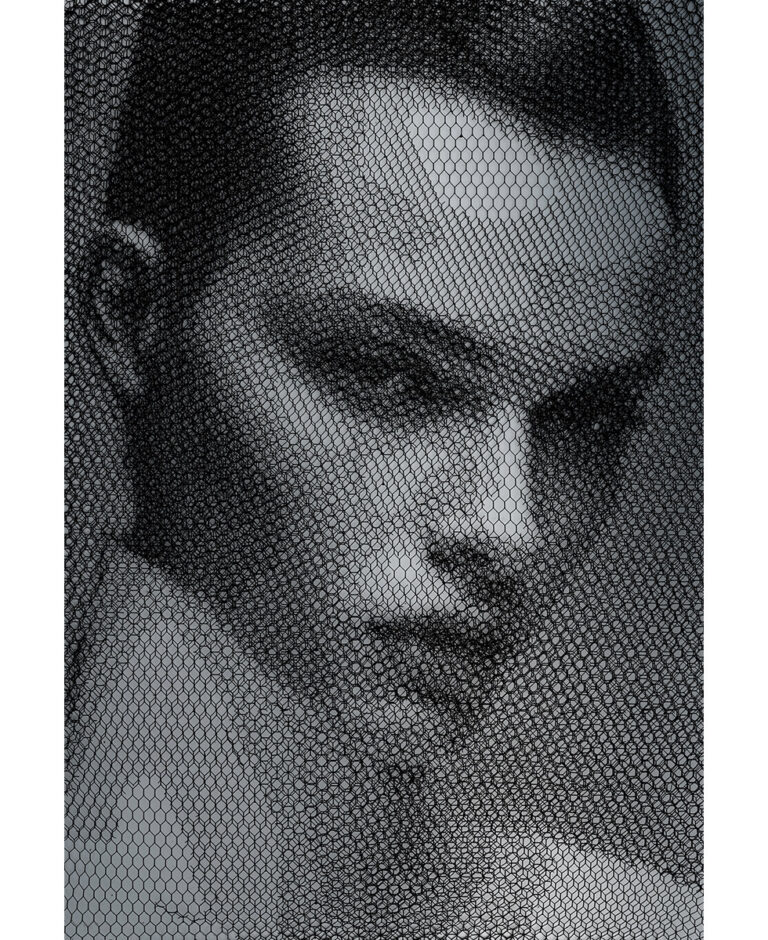
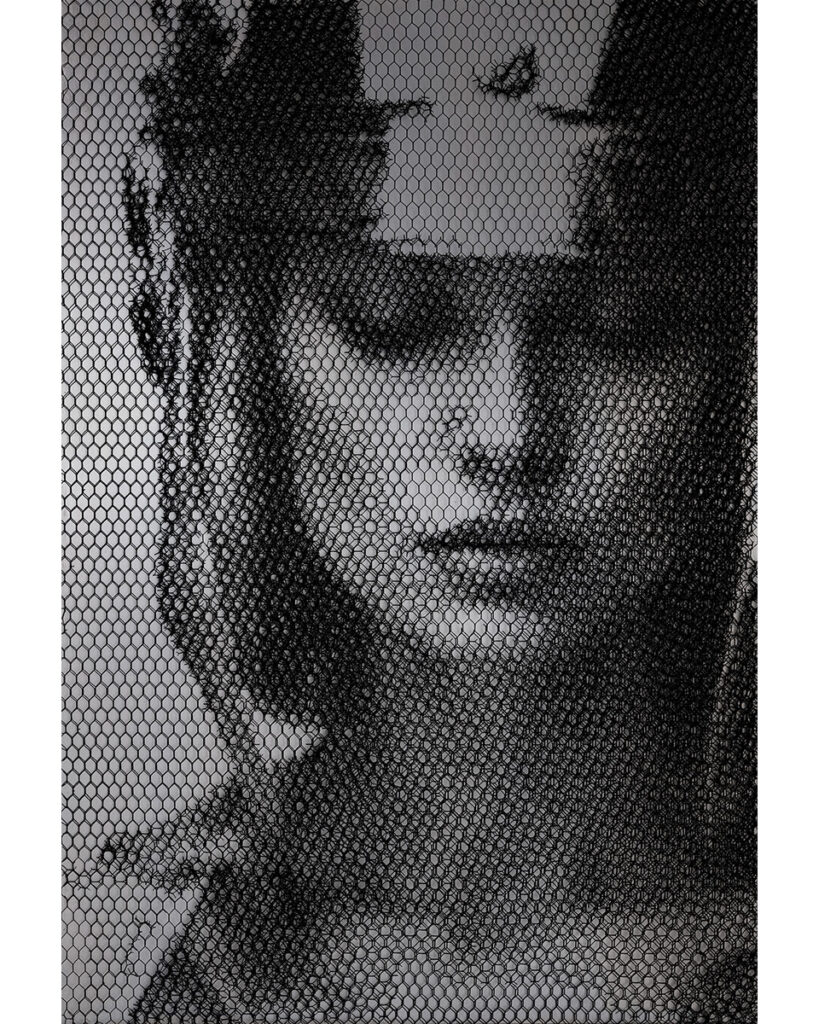
Minerva is strategic intelligence, disciplined thought, the ability to design. She is not only knowledge, but the conscious use of knowledge. She represents a directed form of knowing: selecting, organizing, anticipating. Not everything that is known is useful; what matters is the ability to build direction. This figure introduces a project-oriented dimension: knowledge becomes a tool, capable of guiding decisions, constructing scenarios, anticipating developments. The metal mesh operates through precision and reduction. The face appears defined, essential, as if every element were the result of a choice. Nothing is accidental; everything contributes to the construction of the image.
MINERVA – ALGOR. 3171538 (EÍDŌLON), 2024
hand-cut black wire mesh on metallic grey background
125 × 85 cm.
Apollo is light, revelation, clarity. He is the moment in which something becomes evident, when a form distinguishes itself, when a possibility manifests. He represents knowledge as discovery: not accumulation, but emergence. What was previously indistinct becomes visible, recognizable, usable. This dimension introduces the moment of full understanding: when a complex system produces a clear result, when a hidden relationship becomes legible. The metal mesh allows the face to emerge with greater sharpness. The image appears as if illuminated from within, as if the structure had reached a point of balance between complexity and clarity.
APOLLO DI KASSEL – VISTA 111811 (PAGAN POETRY), 2024
hand-cut black wire mesh on saffron yellow background
70 × 70 cm.
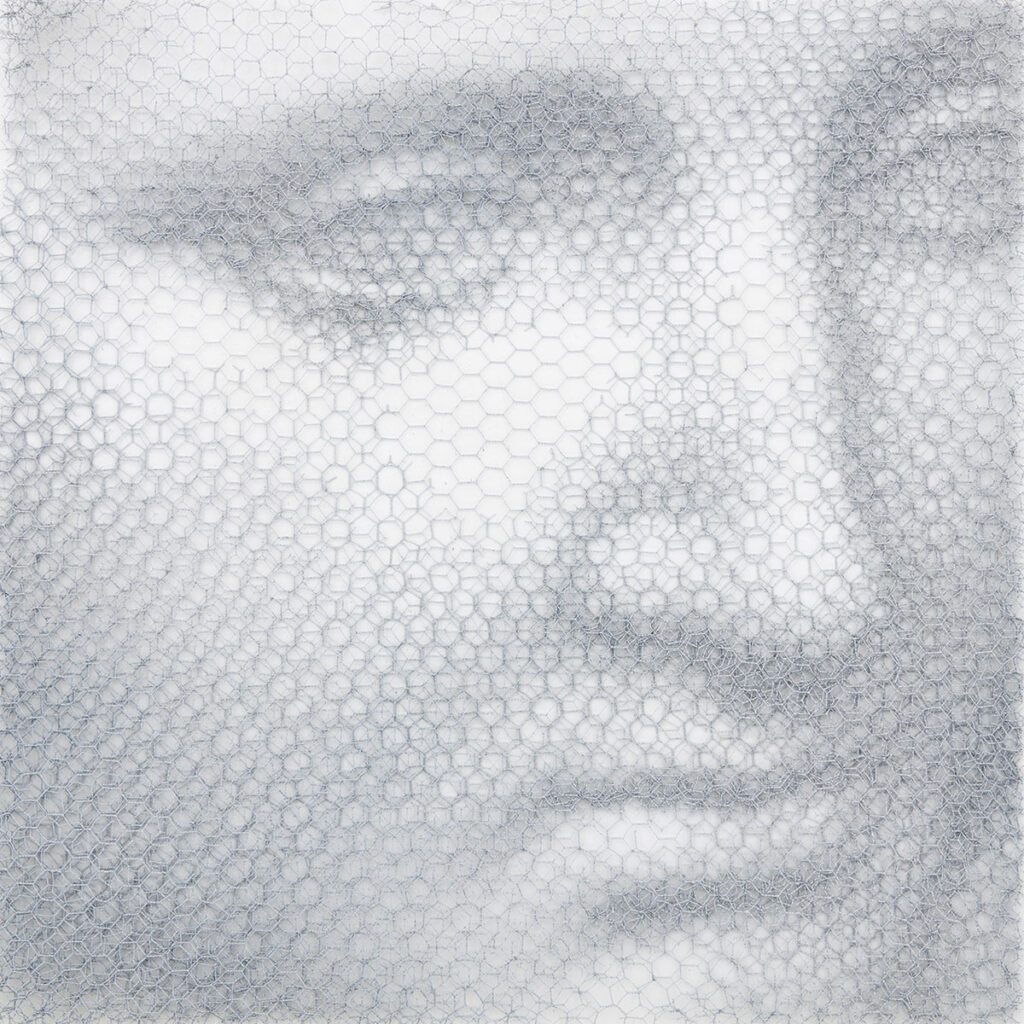
Calliope is memory, writing, transmission. She is what allows knowledge to endure, to be shared, not to disperse. She represents knowledge as deposit and continuity. What is observed and understood does not remain in the immediacy of experience, but is structured, fixed, and becomes accessible to others. Knowledge truly exists only when it can be transmitted. This dimension introduces a reflection on the very nature of knowledge: what remains is never the event itself, but its trace. Every form of knowledge is always, in some way, a translation, a recording, a mediated memory. In this work, the white metal mesh on a white background makes this condition visible. The image does not assert itself through matter, but through its shadow. What appears is not the structure itself, but its projection: an indirect, fragile presence, constructed by light. Knowledge thus takes the form of a trace: not full, not definitive, but sufficient to orient the gaze. Like writing, it exists insofar as it can be read.
CALLIOPE – VISTA 3 (PAGAN POETRY), 2020
hand-cut white wire mesh on white background
70 × 70 cm.