 Experience
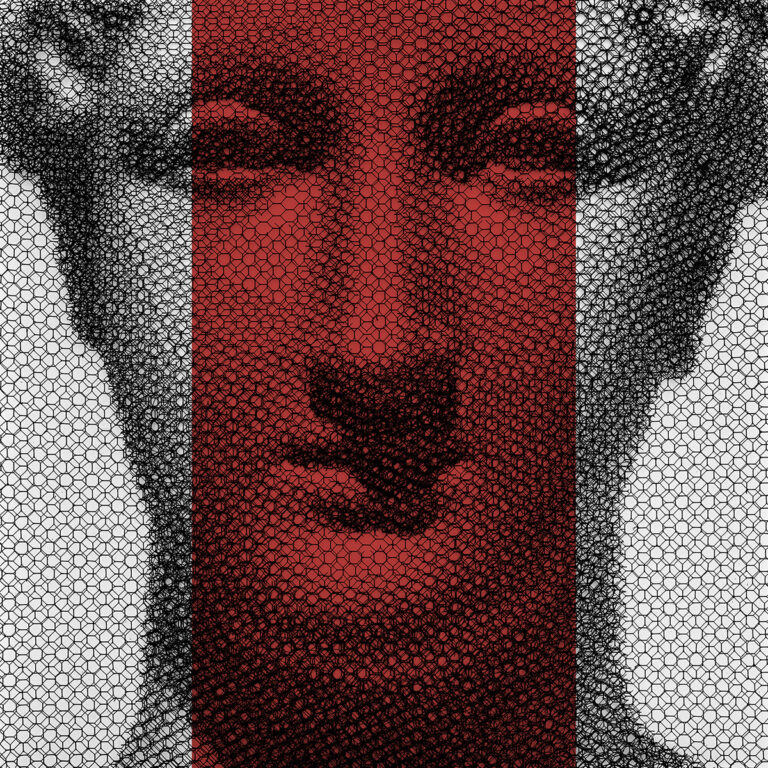
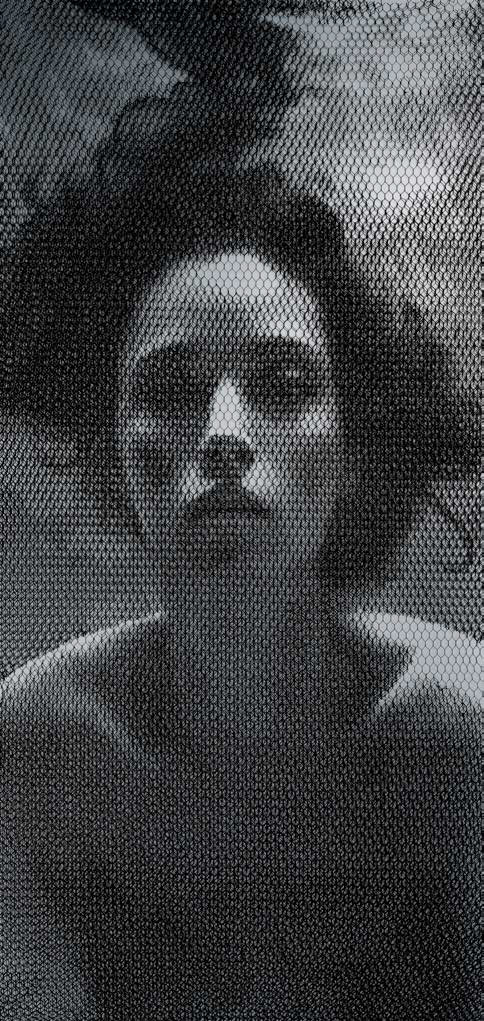
Innovation does not merely consist in understanding what exists, but introduces a new possibility. It can be read as development — when an already defined system is transformed, expanded, pushed beyond its limits — or as an initial condition, when what appears as an outcome reveals a generative logic still in progress. In both cases, innovation is not a linear passage, but a tension: it implies risk, intuition, and the ability to imagine what is not yet visible. Here, the body presents itself as a field of possibility. It is not only an object of knowledge, but a space in which knowledge can produce transformation. The space that hosts this section amplifies this dimension. The Triumph of Venus, with the presence of Eros and the symbolic elements that accompany it, constructs a system in which beauty is not only representation, but a generative principle. Harmony is not given, but produced. The room configures itself as an environment where arts and languages intertwine: painting, myth, and decoration contribute to building a unified field, in which every element participates in the formation of a collective image. In this context, beauty is not a static value, but a process. As in Neoclassicism, it arises from construction, from a system of rules; yet, in its dialogue with contemporaneity, it opens to new modes of generation. Here, the dialogue between Pagan Poetry and Eídōlon becomes particularly evident. The works of the first series carry with them a form already accomplished, sedimented in tradition; those of the second introduce instead images without a stable origin, generated from a network of data and possibilities. Between these two dimensions a tension is constructed: not between past and present, but between consolidated form and emerging form, between model and generation. At this stage, the mesh assumes an additional function. It is no longer only a structure of connection or a device of reading, but a field of transformation. Information is not only organized, but reworked, recombined, pushed beyond its initial state. The mesh becomes generative. The figures that inhabit this space — Hercules, Prometheus, Adonis, Hera, Hephaestus, and Hygieia — embody different modalities of this passage: disciplined strength, discovery, potential, protection, technical construction, prevention. They do not represent a linear evolution, but different possibilities: ways in which knowledge can become action, transformation, and opening. Within this horizon also lies contemporary research, which increasingly operates through complex systems, integrated platforms, and predictive models. It does not limit itself to observing the body, but intervenes in its mechanisms, seeking to anticipate and modify its developments. In this space, the body is configured as a field upon which it is possible to act in new ways, where understanding and transforming become part of the same process. Crossing this room — in one direction or the other — one awareness emerges: to innovate does not mean to replace what exists, but to transform it, generating new possibilities from what has already been constructed.
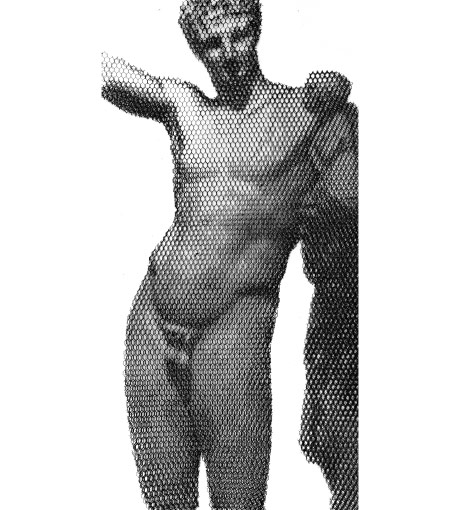
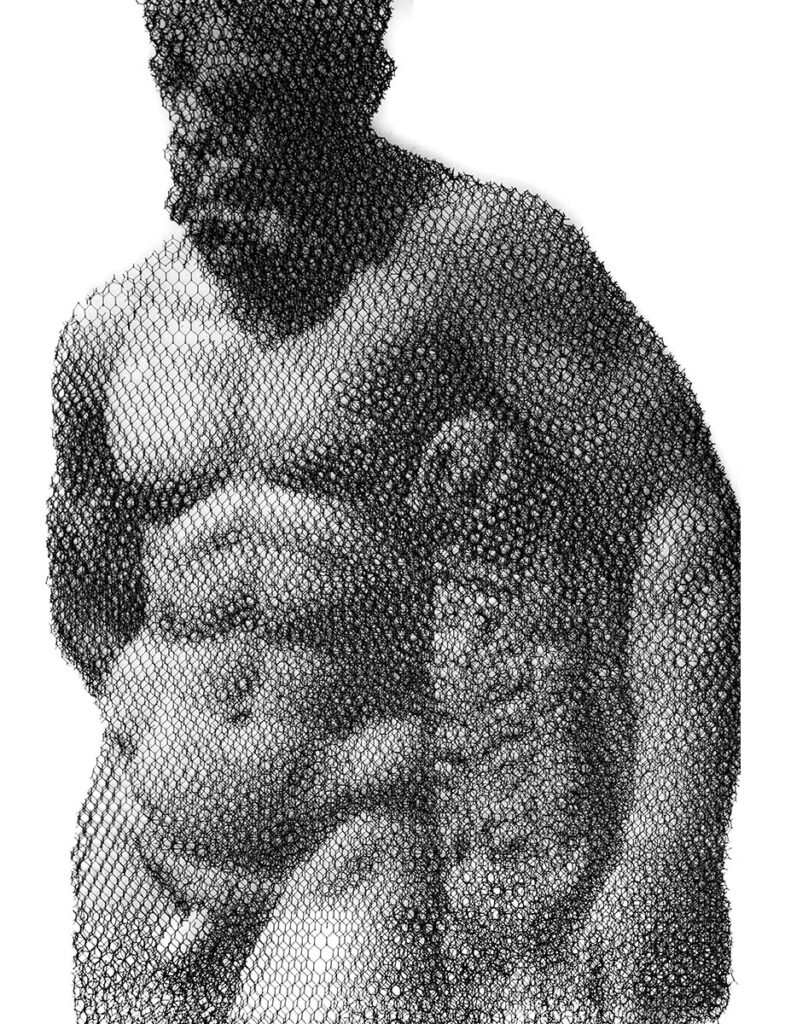
Hercules is disciplined strength, resistance to trial. His labors are not impulsive acts, but repeated actions, built over time, that transform obstacles into possibilities. He represents a form of innovation that does not arise from sudden intuition, but from persistence. Change requires duration, the ability to face complexity without simplifying it. Every advancement is the result of a process, not an isolated event. The figure, derived from classical statuary, carries with it an idea of an already defined body, constructed according to measure. In this context, however, that form is not a conclusion, but a starting point: a structure that can be traversed and placed under tension again. The metal mesh holds this solidity and at the same time fragments it. The body appears as if subjected to an internal pressure, as if the classical form were continuously redefined from within.
ERCOLE FARNESE – VISTA 022278 (PAGAN POETRY), 2025
hand-cut black wire mesh on white background
125 × 85 cm.
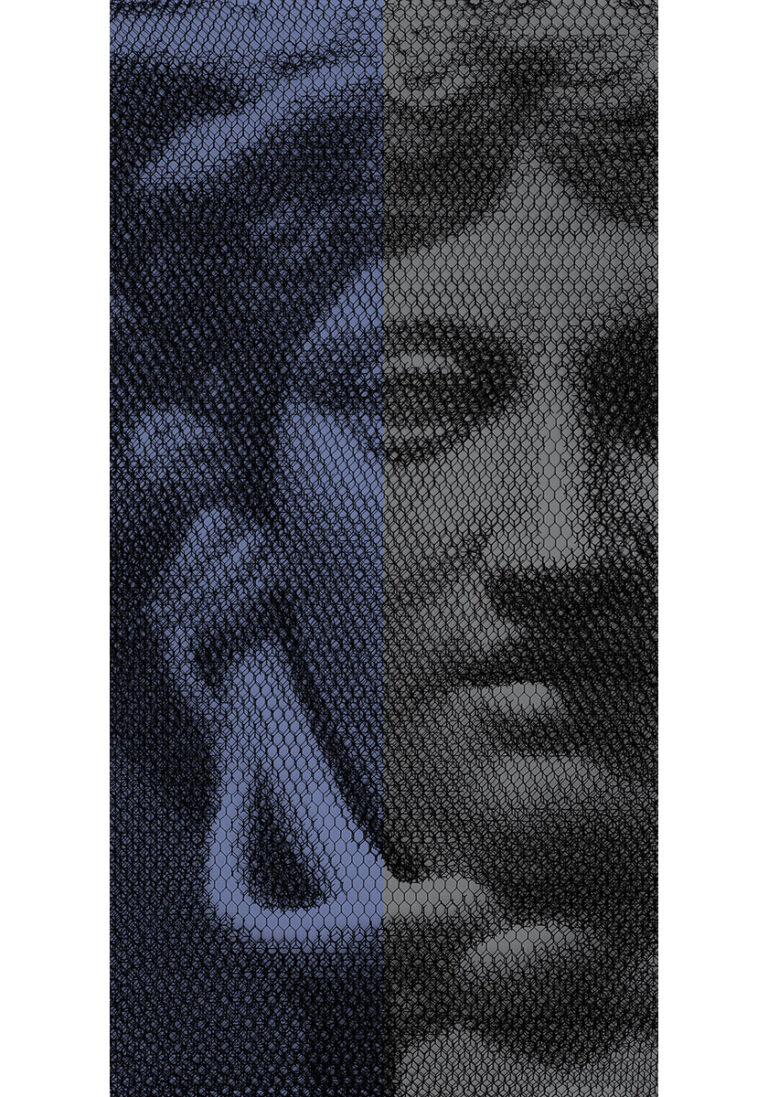
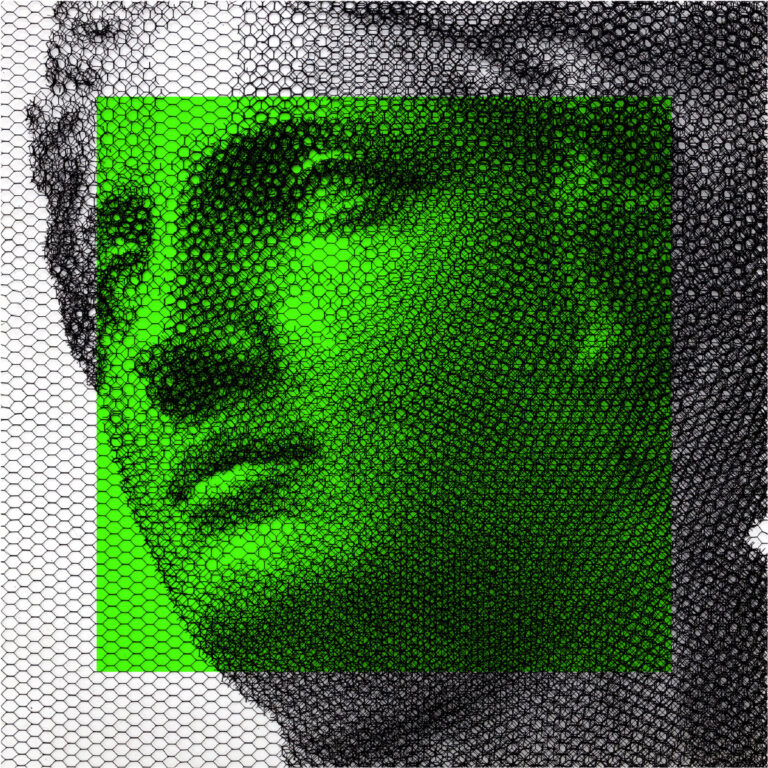
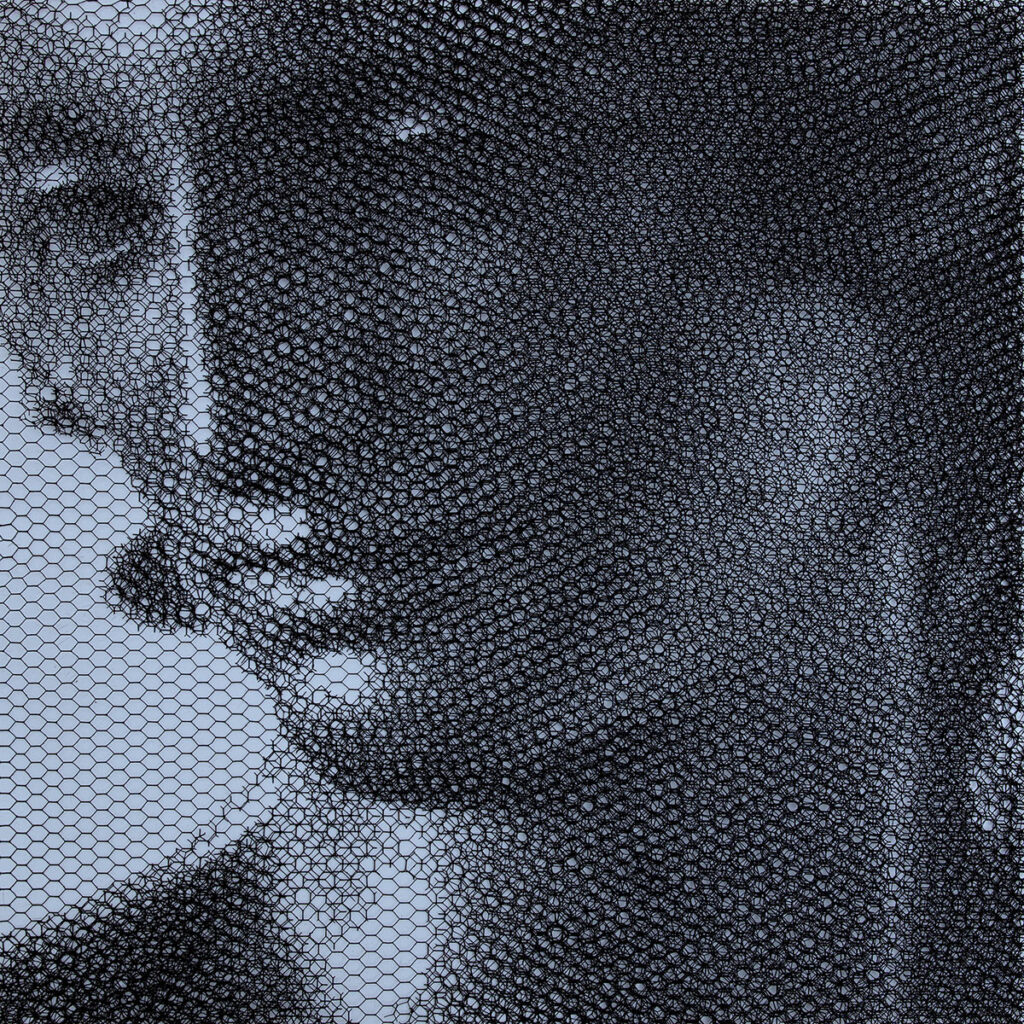
Prometheus is the one who brings fire. Not simply a discovery, but an irreversible transformation of the human condition. Fire is technology, possibility, risk. He represents innovation as an act of rupture: a passage that profoundly alters what is given, opening scenarios that are not entirely predictable. Every advancement carries responsibility, because what is introduced cannot be taken back. The figure, still rooted in classical tradition, here takes on a contemporary tension. The form is recognizable, but its meaning shifts: no longer myth, but paradigm. The metal mesh operates like a field of energy. The image is not static, but crossed by a vibration that suggests transformation. The face appears as if exposed to a force that modifies it.
PROMETHEUS – VISTA 042018 (PAGAN POETRY), 2025
hand-cut black wire mesh on light blue background
95 × 95 cm.
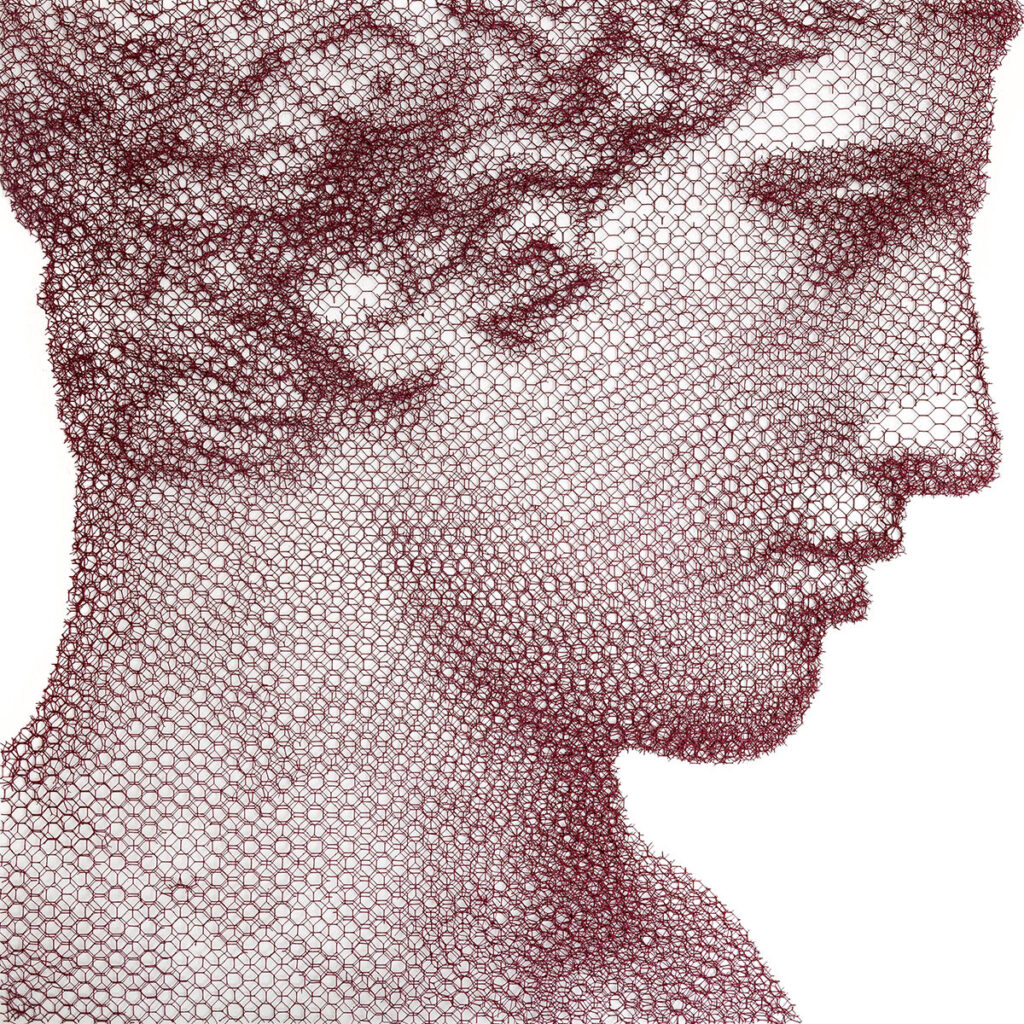
Adonis is youth, beauty, brief intensity. His existence is marked by a tension between absolute vitality and fragility. He represents potential: that which is still in becoming, which has not yet reached stability, but already contains a significant force. Innovation, in this perspective, is always initially fragile. Every possibility must be tested, developed, protected. The form, derived from the classical canon, suggests perfection, yet this perfection is unstable. It is not an endpoint, but a temporary condition. The metal mesh conveys this precariousness. The image appears defined, but not completely stabilized, as if it could change. The form is present, but not definitive.
ADONE – VISTA 012399 (PAGAN POETRY), 2026
hand-cut burgundy wire mesh on white background
95 × 95 cm.
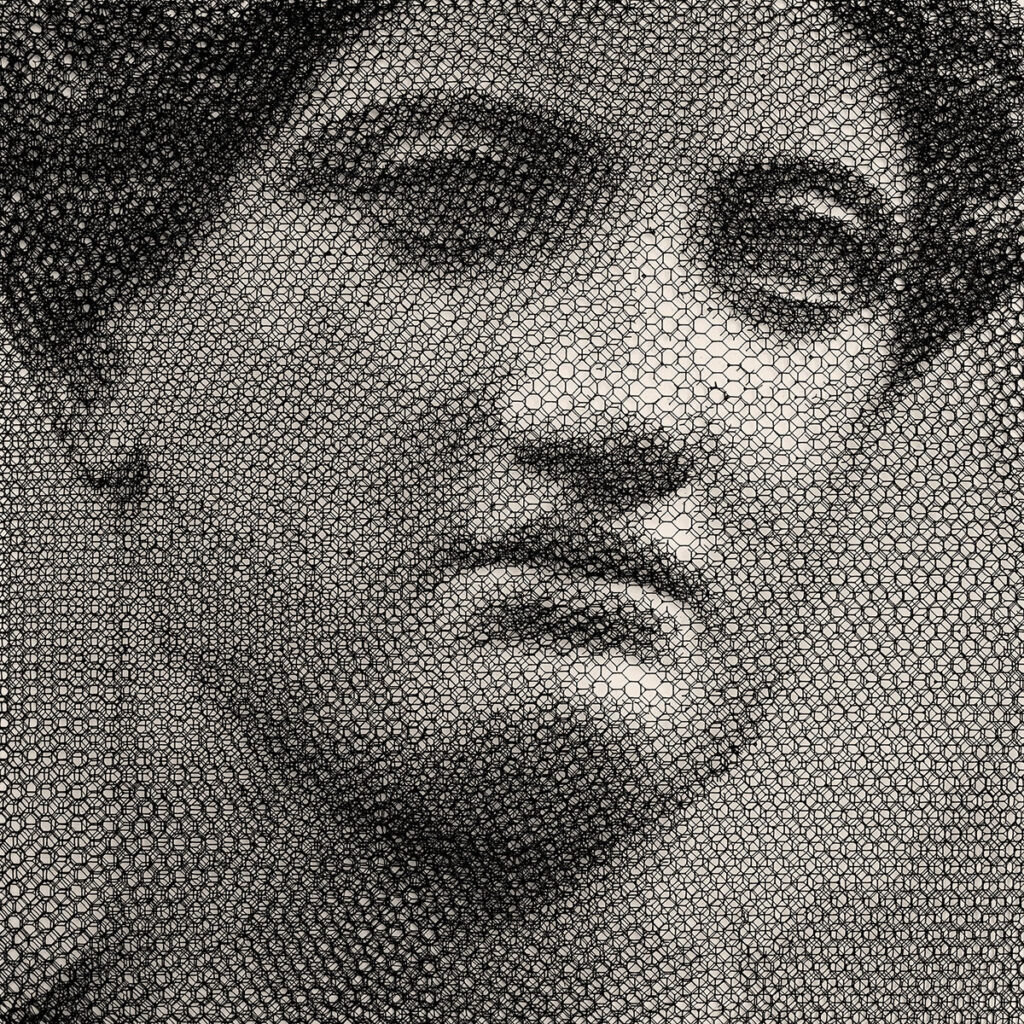
Hera is structure, continuity, protection. She is not only a maternal or regal figure, but a principle of stability: that which allows a system to endure over time. She represents a less visible aspect of innovation: the necessity of building conditions so that what has been developed can be sustained, organized, and distributed. Innovation is not only discovery, but the ability to make it operational and accessible. Without structure, every advancement remains isolated. The figure, firmly rooted in classical tradition, maintains a strong formal presence. The metal mesh does not dissolve it, but reveals its internal construction, as if solidity were the result of a complex structure.
HERA BARBERINI – VISTA 131950 (PAGAN POETRY), 2025
hand-cut black wire mesh on butter-white background
95 × 95 cm.
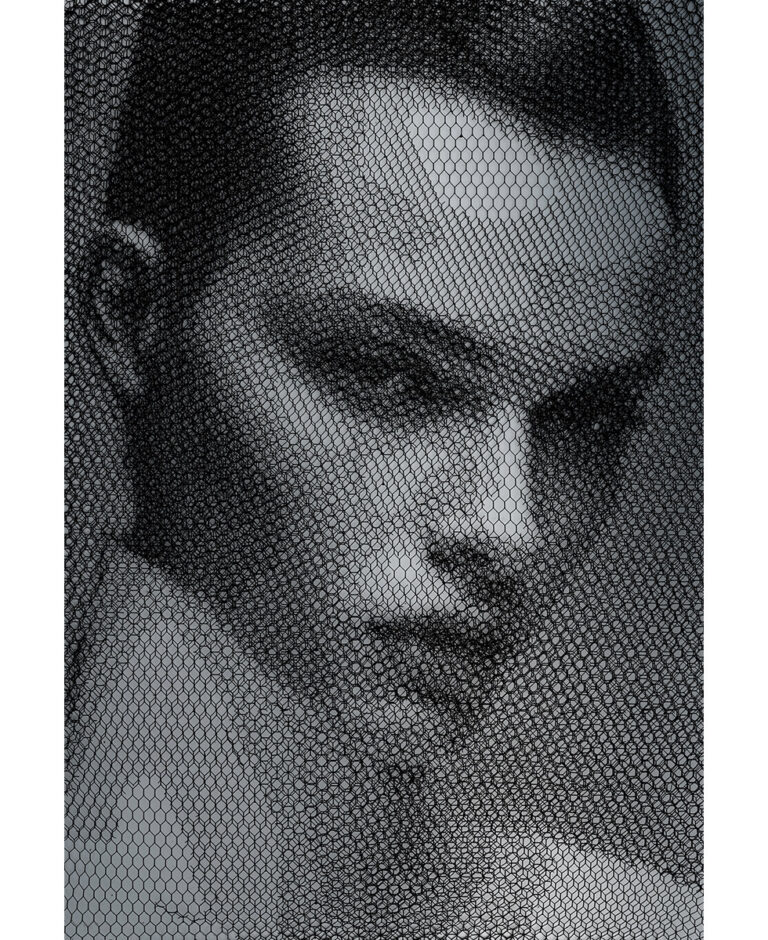
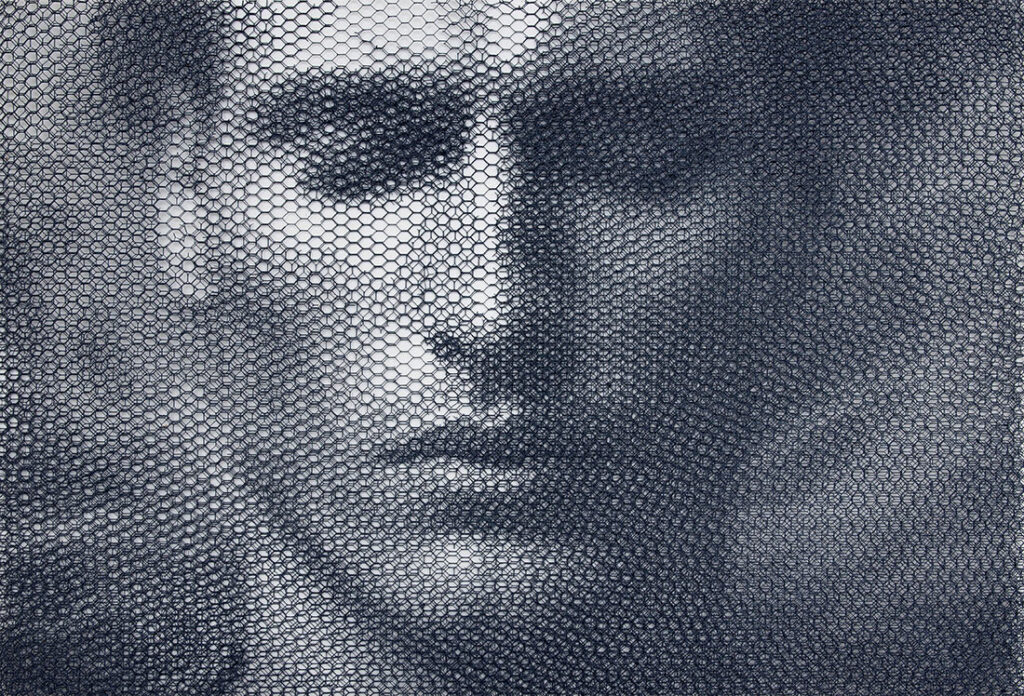
Hephaestus is the god of technique, of construction, of transformed matter. He is the one who works in depth, who shapes, who makes intuition operational. He represents innovation as a technical process: that which translates an idea into a device, into a tool, into a concrete application. It is the passage from thought to realization. Here the dimension shifts. There is no longer an ideal form, but construction. The figure, belonging to the Eídōlon series, does not derive from a historical model, but from a generative system. It does not represent a stabilized archetype, but an emerging possibility. This shift is central: the image is no longer a copy or reinterpretation, but the result of a network of data. It has no single origin, but derives from a process. The metal mesh makes this condition visible. The face appears constructed, almost synthetic, yet not cold. It is a new presence, born from a different logic.
HEPHAESTUS – ALGOR. 181311 (EÍDŌLON), 2023
hand-cut indigo wire mesh on white background
85 × 125 cm.
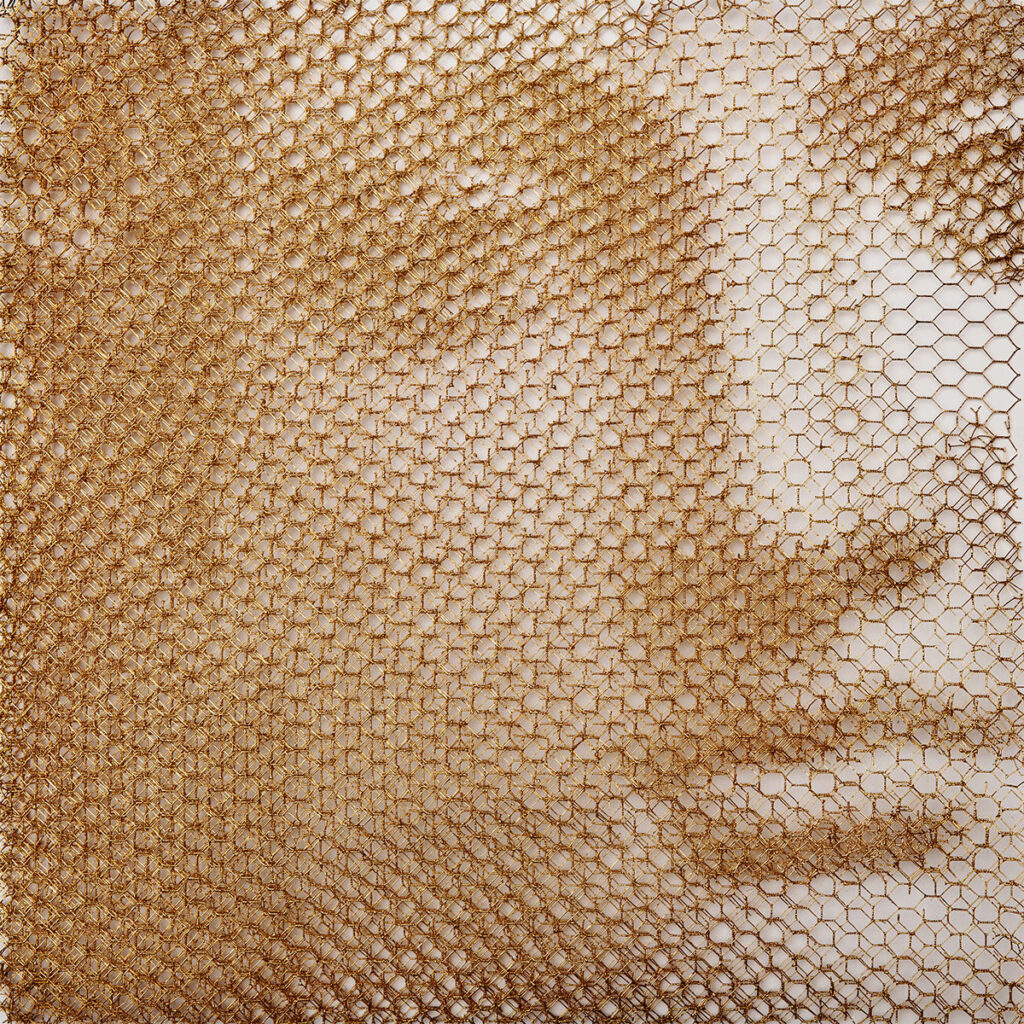
Hygeia is the principle of health as prevention. She does not intervene afterward, but beforehand. She does not treat what has already manifested, but acts on the conditions that make it possible. She represents one of the most significant transformations in contemporary thought: shifting attention from treatment to prediction, from reaction to anticipation. This dimension introduces a form of innovation that is not visible as an event, but as a silent modification of the system. Change occurs before it is perceived. The figure, rooted in classical tradition, appears essential, almost rarefied. The gold plating introduces a different quality: not decorative, but symbolic. Health is not only a biological condition, but a value. The metal mesh constructs a luminous yet restrained image. The face does not impose itself, but presents itself as a balanced, stable presence, as if it had already undergone transformation.
IGEA – VISTA 12 (PAGAN POETRY), 2021
hand-cut 24k gold-plated wire mesh on white background
60 × 60 cm.